Last updated October 15, 2026
DIY vs Professional ADU: The San Diego Homeowner’s Decision Guide
Building an accessory dwelling unit in San Diego looks different once you read the fine print on California’s owner-builder permit. That permit lets you act as your own general contractor, but it also attaches a disclosure to your property title stating the ADU was built without a licensed contractor. When you sell, that disclosure can shrink your buyer pool to cash offers and portfolio lenders. This guide walks through the real decision: what the law allows, what lenders require, where DIY savings are genuine, and where they evaporate on the first failed inspection. If you’re weighing whether to build your own ADU or hire a licensed San Diego contractor, our How to Hire a ADU Contractor in San Diego: A Step-by-Step Guide can help, and you’ll find the numbers, the code requirements, and the risk calculation laid out in plain terms.
Quick Answer
For most San Diego homeowners, DIY makes financial sense only for finish work like painting, demo, and site cleanup. Electrical, plumbing, structural framing, and any work requiring a permit signature should be handled by a licensed contractor. The reason is straightforward: California’s owner-builder permit triggers a resale disclosure that complicates conventional mortgage financing for future buyers, and failed inspections on permitted work routinely cost more in rework than hiring the trade out in the first place.
Table of Contents
- What California’s Owner-Builder Permit Actually Authorizes
- The Resale Disclosure: Why Lenders Care Who Built Your ADU
- Which ADU Work Is Legal to DIY in California
- Which ADU Work Requires a Licensed Trade
- The Real Cost Comparison: Where DIY Saves and Where It Doesn’t
- How San Diego’s Permit Process Creates Accountability Checkpoints
- The Insurance and Warranty Gap During Construction
- Common Mistakes to Avoid
- When to Call a Professional
- Frequently Asked Questions
What California’s Owner-Builder Permit Actually Authorizes
California Business and Professions Code Section 7044 lets a homeowner pull a building permit for their own primary residence without holding a contractor’s license. That’s the owner-builder permit. It is not a loophole; it is a defined legal status with specific limits. You can act as the general contractor, which means hiring and scheduling subcontractors, purchasing materials, and signing off on the work at each inspection stage.
What the permit does not do is let you sell the property without consequence, and it does not let you hire unlicensed workers to do the work for you. If you pull an owner-builder permit and then pay someone unlicensed to do the electrical or plumbing, you’re now someone who hired unlicensed labor, which carries its own penalties and voids the permit’s legal protection. The permit covers you, the owner, working on your own home.
In San Diego, the owner-builder permit follows the same plan check and inspection path as a contractor-pulled permit. The city reviews the same drawings, enforces the same California Building Code, and sends the same inspectors. The permit itself costs less because you are not paying a contractor’s markup on the permit administration, but that savings is usually a few hundred dollars on a project that runs well into the six figures.
The real cost of the owner-builder permit shows up later, at the point of sale. That’s where the disclosure clause does its work.
The Resale Disclosure: Why Lenders Care Who Built Your ADU
When you sell a home with an ADU built under an owner-builder permit, California law requires you to disclose that the structure was constructed without a licensed contractor. This is not a small note in a stack of paperwork. It is a material fact that real estate agents, escrow officers, and mortgage underwriters all see.
Conventional lenders, including those underwriting Fannie Mae and Freddie Mac loans, look at who performed the construction. If the answer is “an unlicensed owner-builder,” the loan file gets flagged. Some lenders will still fund the purchase, but many will not. Those that do often require a structural engineer’s report, a longer appraisal review, or a higher down payment from the buyer. In practice, the buyer pool shrinks to people paying cash or using portfolio lenders, and both groups negotiate harder on price.
We have seen this play out in San Diego neighborhoods from Clairemont to Chula Vista. A homeowner saves $40,000 building their own ADU, sells five years later, and watches the buyer’s lender condition the loan on a $3,500 engineer’s certification. The deal survives, but the asking price drops by more than the original DIY savings. The math is not theoretical; it is what the disclosure requirement does in a market where most buyers finance with a conventional mortgage.
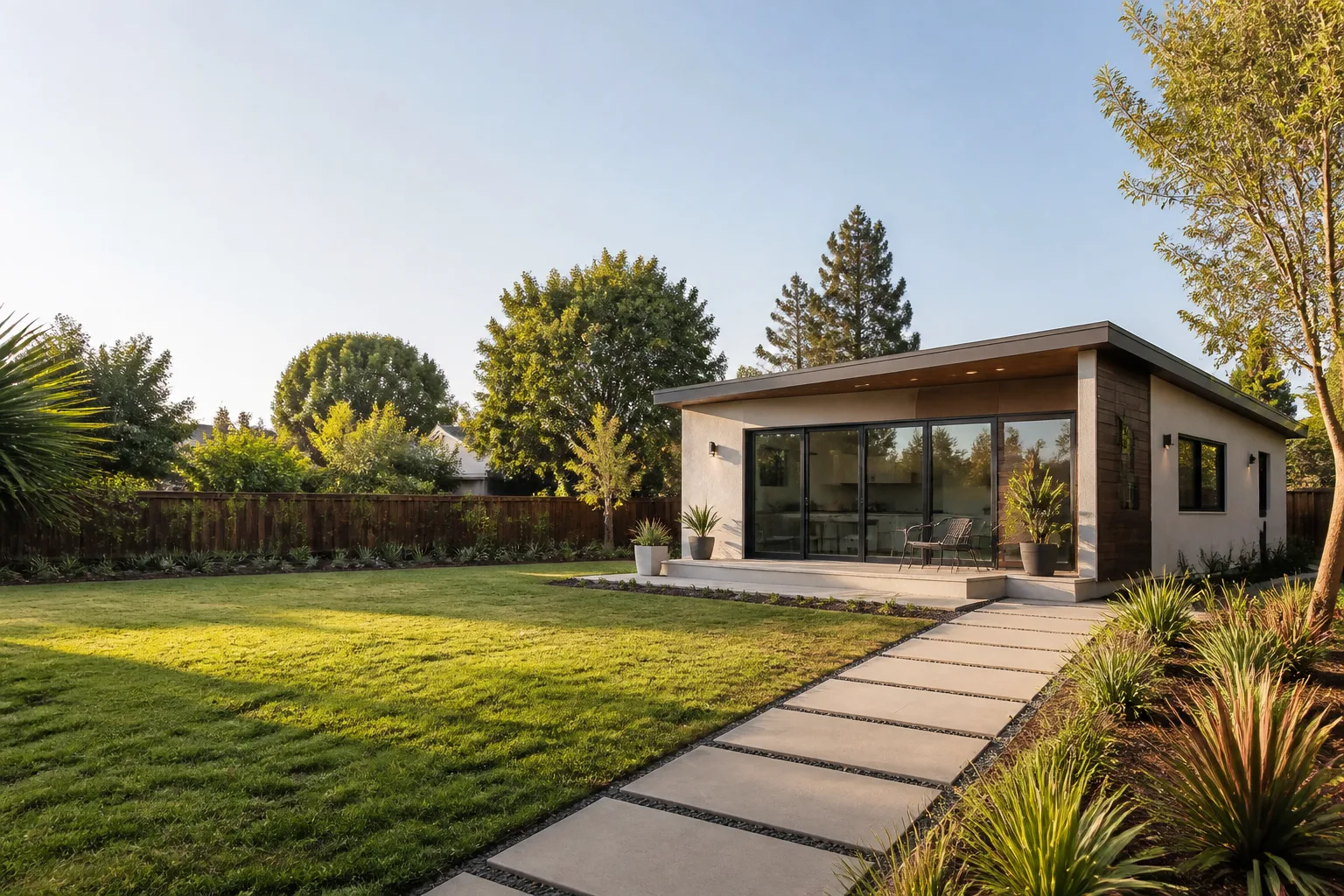
An ADU built by a licensed contractor like Fielding ADU Builders in San Diego carries no such disclosure. The permit history shows a licensed contractor of record, the work passes standard underwriting review, and the resale value of the ADU holds.
Which ADU Work Is Legal to DIY in California
California law is specific about which work an owner-builder can perform without a license. The rule of thumb: anything that does not require a licensed trade by state statute is fair game for the owner. That includes several categories of work where the labor savings are real.
Legal DIY Work Categories
- Demolition and site prep: Tearing out old drywall, removing a crumbling patio slab, clearing brush, and grading the build site. No license required.
- Painting and finishing: Interior and exterior painting, staining, sealing. This is the single biggest DIY labor savings in any ADU project.
- Landscaping and hardscape: Building the path from the house to the ADU, planting, laying pavers, building a small retaining wall under four feet high. All legal without a license.
- Insulation (non-spray): Installing fiberglass batt insulation is legal for an owner-builder. Spray foam insulation typically requires a licensed contractor because of the chemical application equipment involved.
- Finish carpentry: Baseboards, trim, closet shelving, and cabinet installation can all be done by the owner.
- Flooring: Laminate, vinyl plank, tile, and carpet installation all fall within legal DIY work.
These categories account for maybe 15 to 20 percent of a typical ADU’s total construction cost. The labor savings here are genuine, because you are saving on hourly labor rates that run anywhere from $40 to $95 per hour in San Diego depending on the trade. On a 500-square-foot ADU, a determined homeowner can save $15,000 to $25,000 doing the finish work themselves.
Which ADU Work Requires a Licensed Trade
California’s Contractors State License Board (CSLB) is unambiguous about the work that requires a license. The state treats this as a consumer-protection issue, not a skills issue. It does not matter how capable you are. The law says these trades need a licensed contractor.
Work Requiring a Licensed Contractor in California
- Electrical: Running wire, installing panels, connecting to the grid, installing outlets and fixtures. Requires a C-10 electrical contractor. San Diego’s electrical inspections are strict, and failed inspections are common for work done by unlicensed hands.
- Plumbing: Water supply lines, drain lines, gas lines, water heater installation, fixture hookups. Requires a C-36 plumbing contractor. Gas line work particularly, given the safety risk involved.
- Structural framing: Walls, roof structure, shear walls, foundation work. Requires a general building contractor (B license) or a framing contractor (C-5). Structural mistakes on an ADU are the single most expensive category of failed inspection to fix.
- HVAC: Installing, moving, or modifying heating and air conditioning systems. Requires a C-20 warm-air heating, ventilating, and air-conditioning contractor. San Diego’s mild climate means smaller HVAC loads, but the permit and license requirements do not shrink.
- Roofing: Roof covering, underlayment, flashing, and any work that touches the roof’s water-shedding surface. Requires a C-39 roofing contractor.
A homeowner who performs this work without a license is violating state law. Worse, the work will almost certainly fail a San Diego inspection, because inspectors look for the contractor’s license number on the permit documentation. When they see owner-builder status paired with work that required a license, the project stops.
The Real Cost Comparison: Where DIY Saves and Where It Doesn’t
The honest cost comparison between DIY and hiring a professional ADU contractor in San Diego is not a simple subtraction of labor rates, which is why our Seasonal ADU Care for San Diego: Year-Round Homeowner’s Guide covers ongoing maintenance costs too. It is a question of where labor savings are genuine and where they get eaten by rework, failed inspections, and change orders.
Where DIY Savings Are Real
| Work Category | Typical DIY Savings | Risk of Rework |
|---|---|---|
| Demo and site prep | $3,000 – $6,000 | Low |
| Finish painting | $4,000 – $8,000 | Low |
| Landscaping and hardscape | $5,000 – $10,000 | Low |
| Flooring installation | $3,000 – $5,000 | Low to moderate |
| Insulation (batt) | $1,200 – $2,500 | Low |
These numbers reflect San Diego labor rates, which run higher than the national average. A demolition crew billing $60 an hour per person for a two-day job costs you $1,920 before disposal fees. Doing it yourself over a long weekend saves that entire amount, and there is no inspection risk because demo work is not inspected for code compliance.
Where DIY Costs More Than Hiring
Electrical work is the clearest example. A licensed electrical contractor roughs in a 500-square-foot ADU in two to three days at a cost of $8,000 to $12,000 in San Diego. An ambitious homeowner spends two weeks reading code, watching videos, and pulling wire. The first inspection fails on three items: wrong wire gauge on a 20-amp circuit, a junction box buried behind framing without access, and a missing AFCI breaker. Re-inspection fees, the cost of pulling wires back out, and the second inspection date add $1,500 to $2,500 to the project, and two weeks turn into five.
Plumbing follows the same pattern. A failed pressure test on a DIY drain line means cutting into walls to find the leak. That rework costs more than the original plumbing bid would have.
Structural framing is the most expensive DIY mistake category. A shear wall nailed with the wrong nail size or spacing fails inspection in San Diego, because the city enforces seismic code strictly. Removing and re-nailing a shear wall on an ADU can cost $4,000 to $7,000 in labor and materials, and it delays the entire project by weeks while the inspector’s calendar fills up.
We have seen these numbers play out on garage conversions and ADU projects across San Diego. The homeowners who call us after a failed DIY attempt typically spend 20 to 30 percent more than if they had hired the trade out from the start.
How San Diego’s Permit Process Creates Accountability Checkpoints
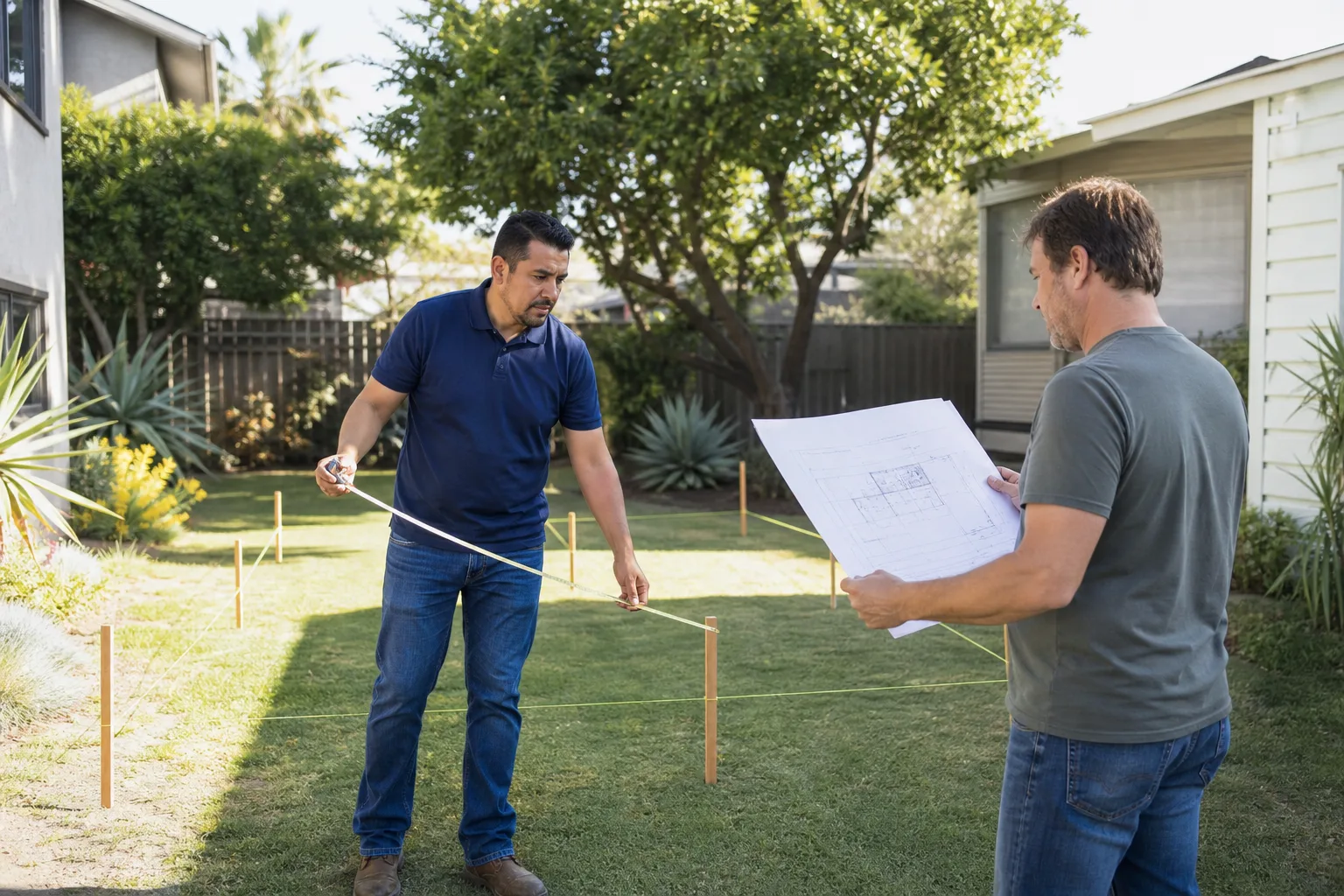
San Diego’s ADU permit process follows a defined sequence, and each stage is a checkpoint that a DIY project must pass. The city is not checking whether the work looks good; it is checking whether the work meets California Building Code. Those are different standards.
The San Diego ADU Permit Path
- Plan check: You submit architectural drawings, structural calculations, and site plans. The city reviews them for code compliance. A plan check on an ADU typically takes 30 to 60 days in San Diego, though the city has streamlined this in recent years under state ADU mandates.
- Foundation inspection: After footings are dug and rebar is set, the inspector verifies depth, spacing, and concrete mix before the pour. This is a one-visit checkpoint. Fail it, and the pour waits.
- Rough framing inspection: Walls, floor joists, roof framing, and shear walls are checked for structural integrity, nailing patterns, and hold-down placement. San Diego inspectors pay close attention to seismic detailing because of the region’s fault lines.
- Rough electrical and plumbing inspection: All wire runs, conduit, drain lines, and vent pipes must be visible and code-compliant before drywall goes up. This is the inspection where unlicensed work most often fails.
- Insulation inspection: R-value checks, vapor barrier placement, and fire-blocking verification.
- Final inspection: The complete ADU is reviewed for habitability, safety, and code compliance. This is where the certificate of occupancy is issued, and without it, the ADU is not legal to rent or occupy.
A licensed contractor moves through these checkpoints predictably because the work is done to code the first time. A DIY project stalls at the rough electrical or rough framing stage, not because the homeowner is incompetent, but because code compliance is a professional skill that takes years to develop. Each failed inspection costs $200 to $400 in re-inspection fees, plus the material and labor cost of correcting the violation.
The Insurance and Warranty Gap During Construction
Most homeowners’ insurance policies exclude construction activity. The standard HO-3 policy covers the dwelling as it exists, not as it is being altered. The moment you tear into a wall or pour a foundation, the policy’s coverage becomes unclear, and many policies explicitly exclude any loss arising from construction, renovation, or remodeling work exceeding a certain dollar threshold.
A licensed contractor carries general liability insurance and workers’ compensation coverage. If a subcontractor is injured on your property, the contractor’s policy responds. If the electrical work causes a fire during construction, the contractor’s liability coverage responds. If the roofer drops a bundle of shingles on your neighbor’s car, the contractor’s policy responds.
An owner-builder carries none of that protection for the trades they hire. If you hire a day laborer to help with demo and he injures himself, your homeowners’ policy likely will not cover the claim. You are personally liable. The California Supreme Court has repeatedly held that homeowners acting as owner-builders assume the liability of a general contractor, including responsibility for workplace injuries on the site.
Beyond insurance, there is the warranty question. A licensed contractor in California is required by law to provide a workmanship warranty of at least one year on new construction. Our own room addition and ADU work in San Diego carries a written one-year guarantee through The Garrison Standard: if something fails inside that year, we return and correct it at no charge. An owner-builder has no such warranty. Whatever is built wrong is yours to fix, on your own dime, whenever it fails.
Common Mistakes to Avoid
- Pulling the owner-builder permit before reading the resale disclosure requirements. The permit is easy to get, but the disclosure attaches to the property forever. Read the language before you commit.
- Assuming the savings math is simple. DIY labor savings are real on finish work, but failed inspections on structural, electrical, or plumbing work routinely cost more than hiring the trade out.
- Hiring unlicensed workers to help with your owner-builder project. This is the fastest way to void your permit protections and expose yourself to liability for injuries on the site.
- Skipping the plan check to save time. San Diego enforces plan checks on ADUs, and building without one results in a stop-work order that costs more than the plan check fee.
- Underestimating the inspection calendar. San Diego’s building department schedules inspections days to weeks out. A DIY project that fails serial inspections stretches a six-month build into a year or more.
- Ignoring HOA restrictions if the property is in a covenant-controlled community. Some San Diego HOAs restrict ADUs even where state law preempts city zoning. Check your HOA documents before you design.
- Using the wrong construction method for the lot. A prefab ADU from a company like Cover or Boxabl may be the right choice for a flat lot with easy crane access, but a steep hillside lot in La Jolla or Point Loma may require conventional stick-framed construction. We work with prefab platforms like Abodu, Dvele, and Mighty Buildings as well as conventional builds, because the right method depends on the site, not the brochure.
When to Call a Professional
If your ADU project involves new electrical service, plumbing connections to the main line, structural work on an existing garage, or anything that requires a plan check, call a licensed contractor. If you want the ADU to appraise at full value when you sell, call a licensed contractor. If you do not want to carry construction liability on your personal insurance, call a licensed contractor. The DIY decision is right for finish work and site prep. For everything else, the City of San Diego’s inspection process will tell you the same thing, just slower and with re-inspection fees attached. Fielding ADU San Diego offers free estimates for garage conversions and ADUs across San Diego – call (858) 264-3027 and someone will pick up.
Frequently Asked Questions
Yes, California’s owner-builder permit allows you to build an ADU on your own primary residence without a contractor’s license, but it requires a resale disclosure stating the work was done without a licensed contractor, which can complicate conventional mortgage financing for future buyers. In San Diego, the permit path is the same as for a licensed contractor, including plan check and inspections.
A homeowner who does the finish work themselves can save $15,000 to $25,000 on a typical San Diego ADU, but those savings are concentrated in demo, painting, flooring, and landscaping. Attempting electrical, plumbing, or structural work DIY usually costs more than hiring out, because failed inspections trigger rework costs that exceed the original trade bid. For more guides & resources, or call (858) 264-3027 for an exact cost breakdown on your specific project.
California law requires you to disclose that the ADU was built without a licensed contractor, and that disclosure can shrink your buyer pool because many conventional lenders will not underwrite a loan on a property with an owner-builder ADU. Cash buyers and portfolio lenders will still purchase, but they typically negotiate a lower price than a buyer using conventional financing.
Demolition, site prep, painting, landscaping, batt insulation, finish carpentry, and flooring installation are all legal for an owner-builder to perform without a contractor’s license. Electrical, plumbing, HVAC, structural framing, and roofing all require a licensed contractor under California law, regardless of the homeowner’s skill level.
Most standard homeowners’ policies exclude construction activity, and an owner-builder assumes personal liability for injuries on the job site that a licensed contractor’s insurance would otherwise cover. A licensed contractor carries general liability and workers’ compensation coverage that protects you from those claims during the build.
A typical San Diego ADU plan check takes 30 to 60 days, though the city has streamlined the process under California’s state ADU mandates. The full construction timeline for a 500-square-foot ADU runs five to eight months with a licensed contractor who schedules inspections correctly; a DIY project that fails serial inspections can stretch to a year or more.
The Bottom Line
The DIY-versus-hire decision on a San Diego ADU is not about whether you are capable. It is about what the law allows, what lenders require, and what the resale disclosure does to your property’s value. DIY makes sense for finish work, where savings are real and inspection risk is low. Licensed contracting makes sense for everything else, because the electrical, plumbing, and structural work is legally required to be done by a licensed trade, and because the resale disclosure on an owner-builder ADU is a financial fact that follows the property. Fielding ADU San Diego puts the price in writing before any work starts and stands behind every ADU with a written one-year guarantee. Call (858) 264-3027 for a free estimate. Someone will answer.
Written by Reed Calloway, Owner at Fielding ADU San Diego, serving San Diego since 2006.