Last updated October 15, 2026
The Complete Guide to ADU in San Diego
San Diego approved more ADU permits in 2023 than any other city in California. That sounds like a green light until you learn the other number: roughly one in four permitted ADU projects stalls before construction is finished, and the cause is rarely the framing crew. It’s the homeowner signing a builder’s contract before confirming the lot could legally take the structure they just paid to design. This guide walks the full sequence in the order it actually happens: zoning, financing, permits, then builder selection. If you live in San Diego and you’re considering an ADU, you’ll finish this page knowing exactly what you’re agreeing to before the first nail is driven.
Quick Answer
Building an ADU in San Diego means confirming your parcel’s zoning eligibility first, locking financing second, submitting plans through the City of San Diego’s Development Services Department third, and only then hiring a builder with a written, fixed-price contract. Most detached ADUs under 1,000 square feet follow the ministerial approval path, which avoids discretionary review hearings, and total construction costs in San Diego typically run $250,000 to $400,000 for a new detached unit and $120,000 to $200,000 for a garage conversion. The difference between a smooth build and a stalled one almost always comes down to sequencing these four steps correctly, as explained in our DIY vs Professional ADU: The San Diego Homeowner’s Decision Guide.
Table of Contents
- Confirming Your Parcel’s ADU Eligibility Before You Spend a Dollar
- The Three ADU Types San Diego Allows and Their Size Rules
- Financing Sequence: Why Money Comes Before Design
- The Permit Pathway at the City of San Diego
- What a Written, Fixed-Price Contract Must Include
- Choosing a Builder Without Getting Burned
- What an ADU Actually Costs in San Diego
- The Real Timeline from First Call to Move-In
Confirming Your Parcel’s ADU Eligibility Before You Spend a Dollar
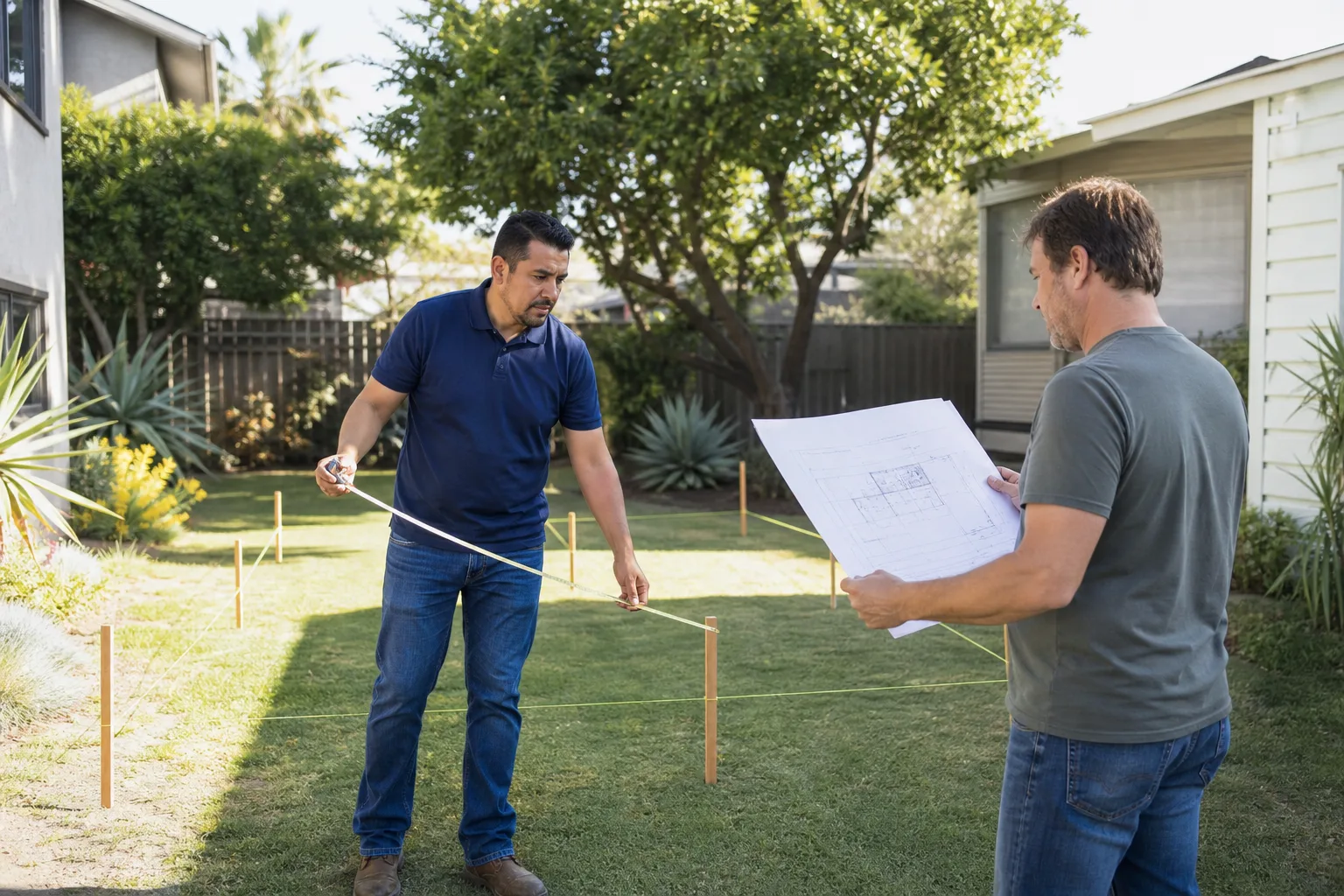
Here’s the order most homeowners follow: hire a designer, pay $8,000 to $15,000 for plans, submit them, and then discover the lot has a setback issue, a slope restriction, or a fire zone requirement that kills the project. Here’s the order that works: pull your parcel number from your property tax bill, open the City of San Diego’s zoning map, and read the development standards for your specific zone before anyone draws a line. This takes an hour and costs nothing.
The City of San Diego uses a parcel-by-parcel system. Your community plan area (Clairemont Mesa, Mira Mesa, Rancho Peñasquitos, Pacific Beach, and so on) carries its own overlay requirements on top of the base zone. A detached ADU that fits easily in University City might violate a hillside setback rule in La Jolla. We’ve walked into estimate appointments where the homeowner had already spent $12,000 on drawings for a structure that could never be permitted as designed. That’s the failure pattern this section exists to prevent.
Start with these three checks:
- Pull your zone designation. Enter your address in the City of San Diego’s official zoning map. You need your base zone (R-1, R-2, RM-1, and similar) and your community plan overlay. Write both down.
- Check the SB 9 and SB 10 overlays. Senate Bill 9 allows lot splits and up to two primary units in single-family zones. Senate Bill 10 allows higher-density zoning near transit corridors if your city council adopted it. San Diego is still phasing in SB 10 adoption by neighborhood, so your parcel may or may not qualify. The map will tell you.
- Measure your setbacks. Standard San Diego rules require a 4-foot side and rear setback for detached ADUs, but ADUs within the setback of an existing primary residence frequently get relief under state law. The catch: hillside overlays, fire zones, and coastal commission jurisdiction add restrictions that state law does not override.
Only after these three checks pass should you pay for a site survey or a designer. If you’re uncertain about any of them, a builder who specializes in ADUs in San Diego can run the check with you. At Fielding ADU San Diego home, we walk every prospective project through this eligibility sequence before taking a deposit. It costs you nothing and it prevents the one-in-four stall statistic from becoming your project.
The Three ADU Types San Diego Allows and Their Size Rules
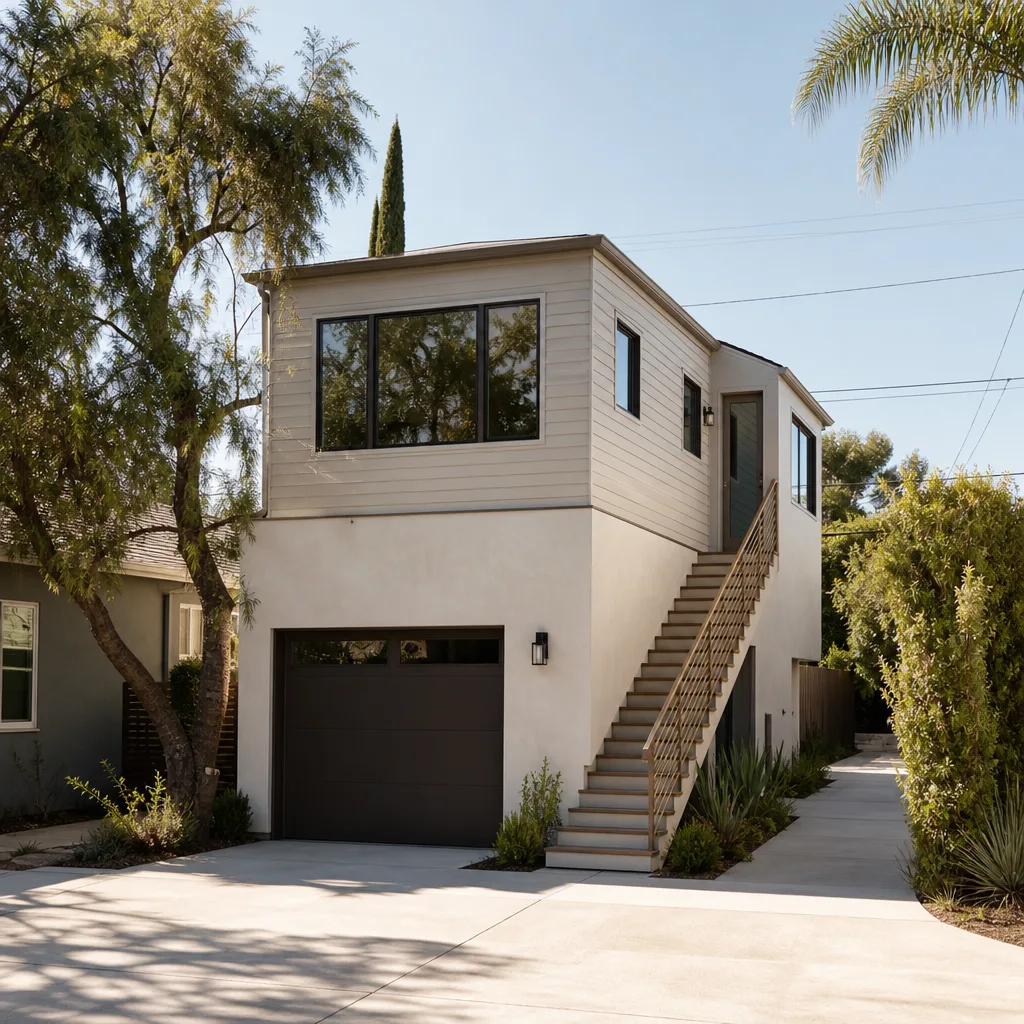
California law standardizes ADU categories statewide, but San Diego’s implementation adds local twists. You can build three types: an attached ADU (connected to the primary home), a detached ADU (a separate structure), and a Junior ADU or JADU (a conversion within the existing home’s footprint, capped at 500 square feet). Each carries different size limits, and those limits shift depending on your zone and lot dimensions.
Here’s the oversimplified version most guides skip: the size rules are not one-size-fits-all in San Diego. State law sets a maximum of 1,200 square feet for a detached ADU, but San Diego’s Community Plan updates have shaped local standards. Many single-family parcels in San Diego allow a detached ADU up to 1,000 square feet without discretionary review. Larger units, up to 1,200 square feet, can still qualify for ministerial approval in many zones, but the path tightens when you add a second story or build on a hillside.
These are the numbers we use when we walk a San Diego lot:
- Attached ADU: up to 50% of the primary home’s square footage, capped at 1,000 square feet in most San Diego residential zones, with 850 square feet allowed for a two-bedroom unit regardless of that percentage.
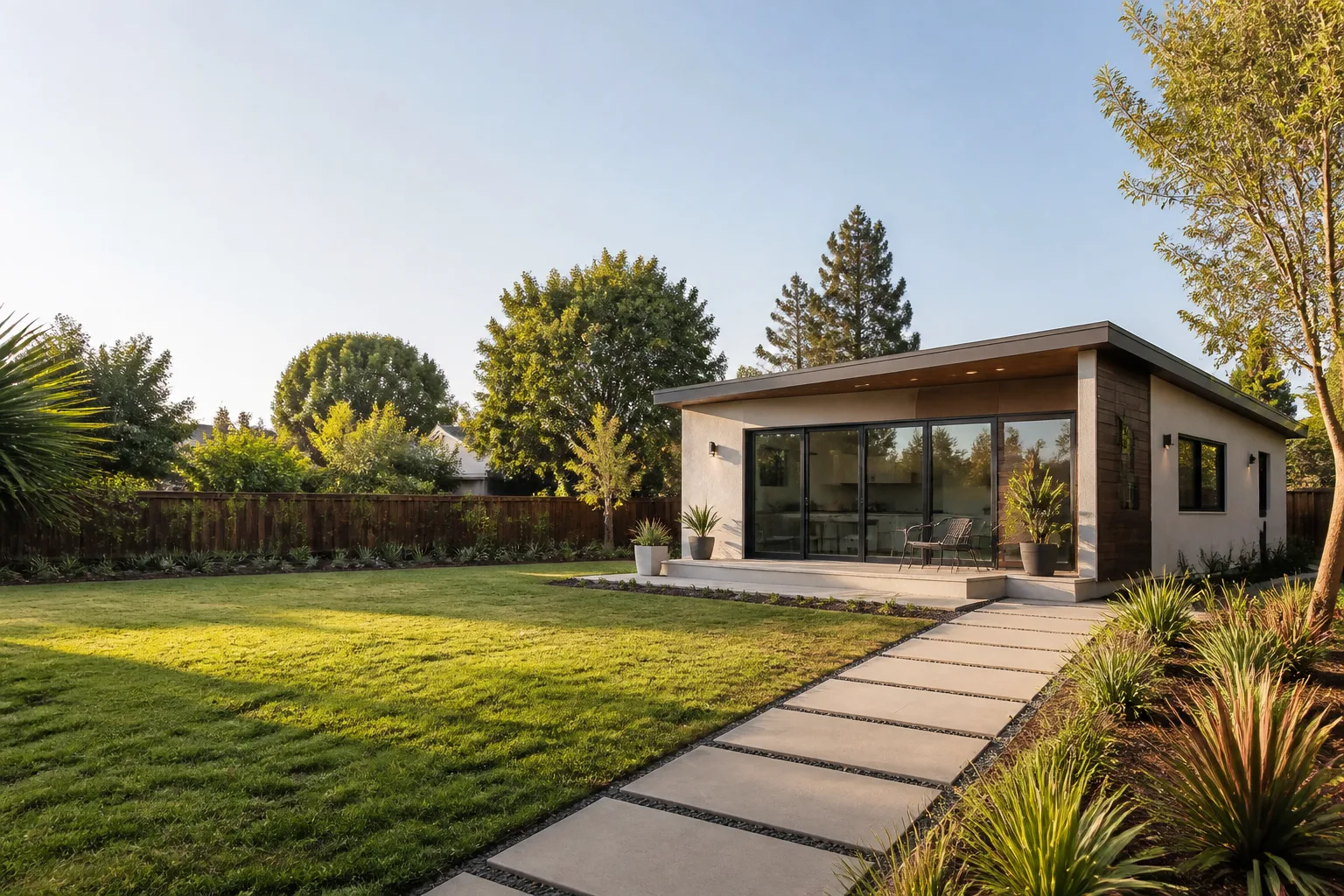
- Detached ADU: up to 1,000 square feet by-right on most single-family parcels in the city of San Diego. One-bedroom detached ADUs are generally capped at 850 square feet.
- JADU: max 500 square feet, must be within the existing walls of the primary home, requires a separate exterior entrance or a door connecting it to the primary unit, and can share a bathroom with the main house. No additional parking required under state law.
Setback relief also deserves a specific note. California changed the standard in 2020: a detached ADU can now be built within a 4-foot rear and side setback even if your zone requires more. But “within the setback” is not the same as “anywhere.” A detached ADU in a fire hazard severity zone in areas like Rancho Bernardo or Carmel Valley still has to meet defensible space requirements that push it further from vegetation and structure lines. Hillside overlays in La Mesa and parts of Clairemont add geotechnical review requirements. This is why a local builder’s familiarity with San Diego’s distinct community plan areas matters more than a generic ADU contractor who has never pulled a permit in the city.
If you’re trying to decide between attached and detached, the decision usually comes down to lot shape. A deep, narrow lot in North Park or South Park often works best with a detached unit at the rear. A wide lot in Mira Mesa or Scripps Ranch can accommodate an attached addition along the side. We match the type to the lot, not the other way around.
Financing Sequence: Why Money Comes Before Design
This is the step that separates the projects that finish from the ones that sit half-framed for 18 months. The financing question is not “how much can we borrow” but “which lender, which product, and in which order.” Get the sequence wrong and you’ll discover mid-project that your construction draws don’t align with your builder’s payment schedule.
Most San Diego homeowners use one of four funding paths:
- HELOC or Home Equity Loan. Fastest, most flexible, but tied to your existing equity. If you bought in San Diego after 2020, you may have significant equity. If you refinanced at a low rate, pulling a second mortgage resets that math.
- ADU-specific construction loan. Lenders including RenoFi and Figure structure these against the projected post-build value of the property (ARV), which means you can borrow more than your current equity would allow. Draw schedule matters: these funds release in stages tied to inspection milestones, so your builder’s schedule and the lender’s draw schedule must match.
- Cash-out refinance. Best if you bought before 2021 and your current rate is higher than today’s. Worst if you locked a 3% rate in 2020 and would be refinancing into something worse.
- Cash. No bank involvement. This is the cleanest path for garage conversions under $200,000.
The sequence error we see repeatedly in San Diego: a homeowner signs a design contract with an architect, spends $10,000 to $20,000 on plans, then calls the bank and learns their debt-to-income ratio won’t qualify for the construction loan they were counting on. Now they own a set of drawings they can’t fund. The fix is simple: settle the funding source before design begins. Schedule the lender conversation in week one, not week twelve. If you’re working with a builder who builds ADUs in San Diego full-time, they can help you think through which financing path fits your property’s ARV and your current mortgage position-see How to Hire a ADU Contractor in San Diego: A Step-by-Step Guide for what to look for.
The Permit Pathway at the City of San Diego
The City of San Diego Development Services Department (DSD) processes ADU permits through a system that improved dramatically after the state’s SB 9 and AB 68 reforms, but still varies by project type. In 2024 and 2025, a compliant ADU application in San Diego moved through plan check in roughly 3 to 6 months, depending on whether the project hit a discretionary trigger. That’s not a typo. The permitting step is the longest single phase of most San Diego ADU jobs.
The path splits into two routes:
- Ministerial approval. This is the by-right path. Your ADU meets all objective standards, you’re not asking for any variances, and the city is legally required to approve it without a public hearing. Most detached ADUs under 1,000 square feet, most attached ADUs under the 50% rule, and nearly all garage conversions qualify. In our experience, a clean ministerial application in San Diego sees first-round plan check comments in 6 to 10 weeks, with approval in 4 to 6 months total.
- Discretionary review. This triggers when you need a setback variance, a height exception, a Coastal Development Permit (for properties west of the coastal zone line, including parts of Pacific Beach, Ocean Beach, La Jolla, and Point Loma), or any deviation from adopted community plan standards. Discretionary review adds months and requires a public notice period. In San Diego’s coastal zone specifically, a detached ADU behind a bluff-top home can take 12 to 18 months to clear coastal review before the building department even sees the plans.
One nuance most out-of-town guides get wrong: San Diego has not adopted the statewide “ADU permit in 60 days” rule uniformly. State law says a city must act on a ministerial ADU application within 60 days, but “act” means issue comments or request corrections, not approve. The realistic approval window in San Diego remains 3 to 6 months for ministerial projects and 8 to 18 months for discretionary ones. Plan your financing and your builder selection around that range.
If any part of this is unclear on your particular parcel, a San Diego ADU builder who pulls permits regularly can pull your DSD case history and tell you what to expect. We do this on every estimate. It’s the difference between waiting four months and waiting a year.
What a Written, Fixed-Price Contract Must Include
California law requires a home improvement contract to include specific terms: a total contract price, a payment schedule that shows the dollar amount of each progress payment, a description of the work in enough detail that a layperson can identify the scope, and the contractor’s license number. But a legal contract and a clear contract are different documents. The worst builders in San Diego write technically-legal contracts that leave scope gaps, then exploit the gaps with change orders.
Specific red flags we see in contracts we review for San Diego homeowners:
- “Allowances” for major components. An allowance for cabinetry, countertops, or electrical fixtures is a blank check. The contract should show a fixed dollar amount per component, not a range “to be determined.”
- “Labor and materials as required.” This phrase means the builder decides what’s required and charges you for whatever they decide. A fixed scope lists every line item.
- “Permit fees billed separately at cost.” City of San Diego permit fees for an ADU run roughly $5,000 to $12,000 depending on square footage and location. Some builders exclude these from the contract price, which makes their bid look $10,000 cheaper than a builder who includes them. Ask whether permit fees are in or out of the price on day one.
- “Subsurface conditions excluded.” San Diego lots vary wildly: decomposed granite in East County, clay in Mission Valley, fill in coastal areas. A builder who excludes all soil risk from the contract is telling you they will charge for every excavator surprise. A responsible builder does a site evaluation before pricing.
Our fixed-price contract, handed to every client before any work starts, does two things differently from what we see from volume builders: the price is written before the work begins and it is the price you pay at the end, and the scope lists every material and every trade. The Garrison Standard that governs how we operate includes a written one-year guarantee on workmanship: if something fails in that year, we return and correct it at no charge, as detailed in our Room Addition Contractor Maintenance Checklist for San Diego Homeowners. That’s not a marketing claim; it’s a paragraph in the contract. Reed Calloway, who runs Fielding ADU San Diego, has been building this way under the Garrison Partners umbrella since 2006.
Choosing a Builder Without Getting Burned
Here’s the question to ask a prospective ADU builder in San Diego, and it’s not “how much do you charge.” It’s “how many ADU permits have you pulled in this specific community plan area.” A builder who has done ten ADUs in Clairemont will know the DSD reviewer’s tendencies, the geotech thresholds, and the site access challenges in a region with canyons and steep slopes. A builder who has done one ADU somewhere else in California will learn all of that on your project, at your cost, on your timeline.
Once you have the local experience answer, here’s what to verify next:
- Written price before any work starts. The number you approve on day one is the number on the final invoice. If a builder hesitates to put a fixed price in writing, they’re planning to adjust it later.
- Permit history. Ask for the permit numbers. A builder should be able to produce them. San Diego’s DSD has a public records portal where you can verify.
- Who is on your site every day. Fielding ADU San Diego sends background-checked, uniformed crew members to every job. You should always know who is on your property and that they’ve been vetted.
- Phone responsiveness. Call the builder at 7:30 at night. If you get voicemail, remember that during the build you’ll have questions at 7:30 at night. A live person answers our phones around the clock; it’s a simple operational standard that matters more during the stress of construction than it does during the sales phase.
We also carry a working fluency with the prefab and modular platforms San Diego homeowners are already researching: Cover and Dvele for high-end factory-built units, Mighty Buildings for panelized 3D-printed construction, and Boxabl for single-module compact units. We can run a prefab comparison for your lot or recommend conventional site-built construction with James Hardie siding where it pencils out better. The right build method depends on your budget, your lot access, and your timeline. Our job is to give you honest pricing on the method that fits, not to sell you the one we happen to prefer.
For a deeper look at how we compare to other builders, see ADU Builders in San Diego. If you’re considering a conversion instead of new construction, Garage Conversion Contractor in San Diego covers the specific costs and permit path for that option.
What an ADU Actually Costs in San Diego
We give real numbers because you should be able to self-qualify before calling. In San Diego’s current market, a new detached ADU runs $300 to $500 per square foot, all-in, for a conventional site-built unit. Prefab units from manufacturers like Cover or Dvele land in the $400 to $700 per square foot range, with the premium buying factory precision and a shorter on-site construction phase. A garage conversion typically runs $120,000 to $200,000 before permit fees, depending on whether the existing structure needs foundation work, new electrical service, or roof replacement.
Here is the per-project breakdown we quote in San Diego:
- Detached ADU, 750 sq ft, site-built: $225,000 to $375,000 including permits, foundation, framing, finishes, and site work. One-bedroom units cluster at the lower end; two-bedroom units at the higher end.
- Attached ADU, 500 sq ft addition: $175,000 to $275,000 including design, permits, and shared-wall construction. Lower than detached because you’re not paying for a separate foundation, roofline, or utility trench from the street.
- Garage conversion, 400 sq ft: $120,000 to $200,000. The range swings on whether the existing garage slab is structurally sound, whether the electrical panel has capacity, and whether the garage is attached or detached.
- JADU, 400 sq ft within the existing home: $80,000 to $150,000. Least expensive because you’re converting interior space, not creating new square footage.
City of San Diego permit fees and development impact fees add $5,000 to $15,000 on top of these numbers. School district fees for new square footage run approximately $4 per square foot in San Diego Unified and can be higher in districts like Poway. Utilities and site work (trenching for new sewer, water, and electrical service) account for $15,000 to $40,000 depending on how far the ADU sits from the main house and the street.
For a broader comparison of construction costs across project types, our Room Addition Contractor in San Diego page breaks down the numbers for additions that are not ADUs. The pricing logic is different enough that it’s worth understanding before you decide which project type fits your budget.
The Real Timeline from First Call to Move-In
Nobody in San Diego finishes an ADU in six months from the first phone call. The realistic range is 12 to 18 months for a detached ADU and 9 to 14 months for a garage conversion, assuming ministerial permit approval and no coastal review. Here’s where the months go:
- Eligibility check and site assessment (weeks 1 – 2). Zoning map, parcel review, preliminary budget conversation. Free at Fielding ADU San Diego home.
- Financing confirmation (weeks 2 – 6). HELOC, ADU loan, or cash source locked. This runs concurrent with pre-design.
- Design and engineering (weeks 6 – 14). Architectural drawings, structural engineering, Title 24 energy calculations. Prefab customers compress this because the manufacturer provides the drawings.
- Permit submission and plan check (weeks 14 – 30). The DSD window we described above. Ministerial projects pass through first-round comments in 6 to 10 weeks; total approval in 4 to 6 months.
- Construction (weeks 30 – 48). Site work, foundation, framing, rough-in, finishes. A 750 sq ft detached ADU in San Diego takes 4 to 7 months to build. Prefab shaves site time to 2 to 4 months because modules arrive prefabricated.
- Final inspection and occupancy (weeks 48 – 52). DSD final inspection, certificate of occupancy from the city, and your first rent or guest move-in.
This timeline assumes a clean permit path. Coastal zone projects, hillside properties requiring geotechnical reviews, and any project needing a variance will add 3 to 12 months. If someone quotes you a six-month ADU in San Diego, they are either quoting construction only and quietly omitting design and permits, or they don’t know the city’s process.
Common Mistakes to Avoid
- Paying for plans before checking zoning. San Diego is a patchwork of community plan overlays. A structure that works in one neighborhood can violate setback, height, or fire zone rules one zip code over. Confirm eligibility on the city’s zoning map before spending on design.
- Locking a builder before locking financing. A signed contract with a draw schedule that doesn’t match your construction loan’s release terms stalls the job at the foundation. Money first, contract second.
- Signing a contract with allowances. “Kitchen cabinetry: $14,000 allowance” is not a price. It is an estimate with a built-in change order. Require fixed line items for every major component.
- Assuming the permit is fast. San Diego’s DSD has improved, but a ministerial ADU still runs 4 to 6 months through plan check. Budget the time.
- Ignoring the coastal zone. If your property sits west of the coastal boundary in Pacific Beach, Ocean Beach, Point Loma, or La Jolla, you may need a Coastal Development Permit before the city will even look at your ADU. That’s months, not weeks.
- Choosing the cheapest bid without reading the exclusions. A San Diego bid that’s $30,000 below the field almost always excludes permit fees, site work, or utility trenching. Those are not optional line items.
- Skipping the written guarantee conversation. Ask every builder what happens if the roof leaks or the wall cracks in month eight. If the answer is not in writing, it does not exist.
When to Call a Professional
You should call a professional before you spend a dollar, not after. The moment you know you want an ADU on your San Diego property, a builder who does this work full-time can run the zoning check, outline the realistic budget range for your lot, and tell you which permit path you’re on. That pre-contract conversation should be free and it should not come with pressure. Fielding ADU San Diego offers free estimates in San Diego. Call (858) 264-3027 if you’re ready to see whether your lot qualifies and what the project would cost. We will give you a written price before any work starts, and we will stand behind the work for a full year in writing. That’s the standard, not a sales pitch.
Frequently Asked Questions
A detached ADU in San Diego typically costs $250,000 to $400,000 all-in, including permits, site work, and finishes, while a garage conversion runs $120,000 to $200,000. The final number depends on square footage, lot access, foundation conditions, and whether you choose site-built or prefab construction. Call (858) 264-3027 for an exact quote on your specific property; estimates are free.
Plan on 12 to 18 months from first phone call to move-in for a detached ADU in San Diego, with 4 to 6 months of that consumed by the city’s permit review process. Coastal zone projects, hillside lots, or any variance request can extend the timeline by an additional 3 to 12 months. A garage conversion runs slightly faster, typically 9 to 14 months total.
Yes, every ADU in San Diego requires a building permit from the City of San Diego Development Services Department. Most ADUs under 1,000 square feet qualify for ministerial approval, which is faster than discretionary review. Building without a permit risks fines, a stop-work order, and a lien on your property when you go to sell.
California’s ADU laws were written specifically to make small lots workable. A single-family parcel in San Diego can add at least one 850-square-foot detached ADU regardless of lot size, and many parcels can go up to 1,000 square feet. There is no minimum lot size for a JADU. The limiting factors are usually setbacks, fire zone rules in canyon areas, and the practical question of where the structure lands on the lot.
An ADU is a separate living unit with its own kitchen, bathroom, and entrance, built as either an attached or detached structure. A JADU is a smaller unit, capped at 500 square feet, created within the existing walls of your primary home. JADUs can share a bathroom with the main house and cost significantly less to build, which is why they’re common in older San Diego neighborhoods with limited lot space.
Yes, appraisers in San Diego typically value a permitted ADU at $200,000 to $350,000 in added property value, depending on size, finish quality, and rental income. The value is heavily tied to permit status: an unpermitted unit adds almost nothing at resale and can complicate financing. A permitted unit with a certificate of occupancy is a bankable asset. To discuss what an ADU would add to your specific property, call (858) 264-3027 for a free estimate.
The Bottom Line
An ADU in San Diego is the best per-dollar return most homeowners will ever make on their property, but the path to a finished unit runs through zoning first, financing second, permits third, and a carefully-vetted builder fourth. The one-in-four stall rate has a single root cause: homeowners who skipped the front-end verification and signed a contract before confirming the lot was ready. The Garrison Standard has guided this work since 2006: written price before any work starts, permitted work done by the book, and a full year of written guarantee on every project. If you’re in San Diego and considering an ADU, start with the zoning check and explore our more guides & resources. Then call (858) 264-3027 for a free estimate and an honest read on what your property will support.
Written by Reed Calloway, Owner at Fielding ADU San Diego, serving San Diego since 2006.